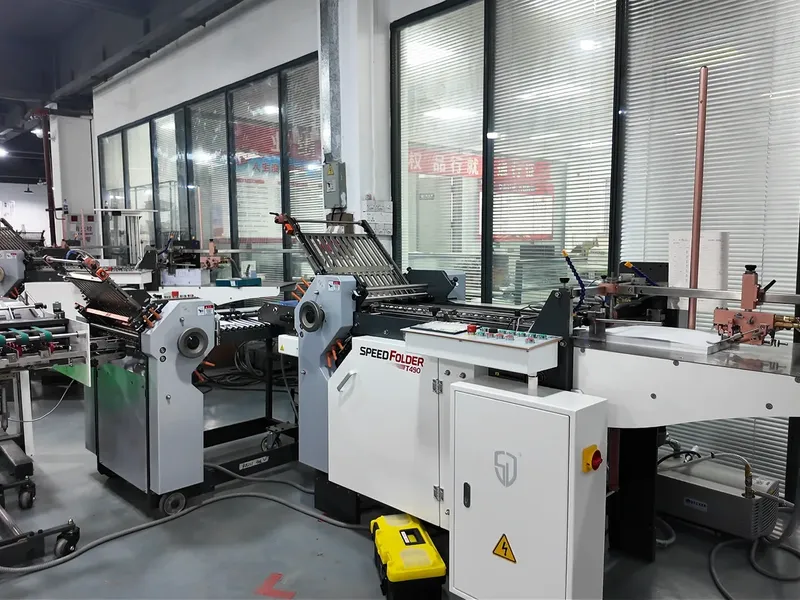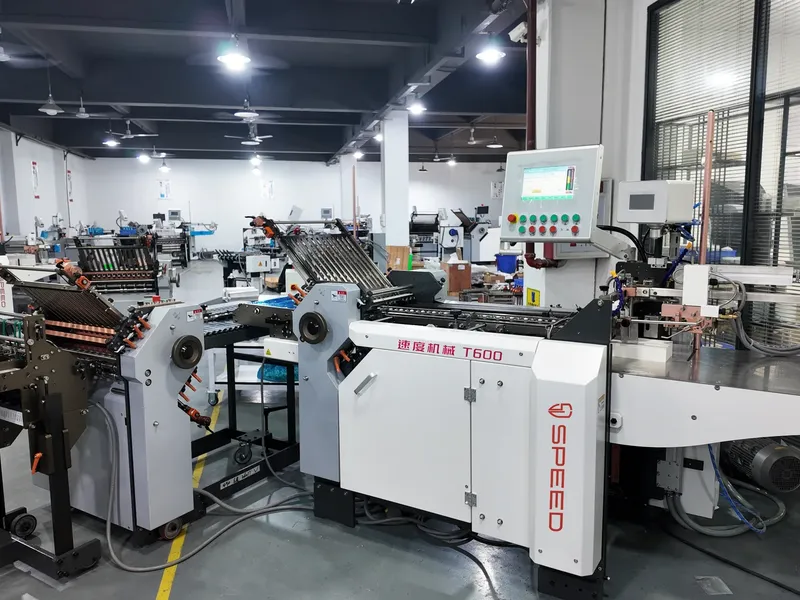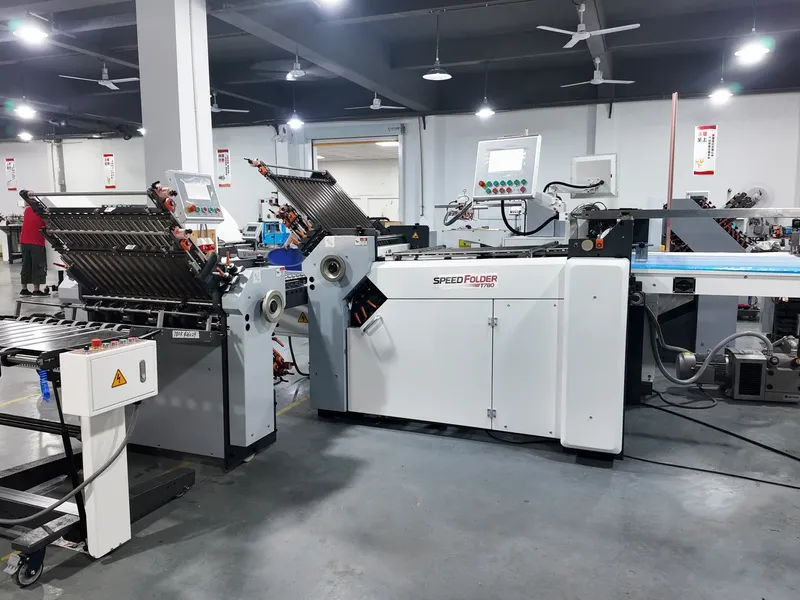
A paper folding machine is a print-finishing machine that creases a printed sheet and folds it along that crease at production speed, so that a flat sheet becomes a leaflet, a brochure, a mailer or a carton insert. It replaces the hand-fold that would otherwise be done at a bench, and it exists because a folded product has to be dimensionally consistent: a leaflet that is 1 mm out of square will not feed a cartoning line, and a brochure that is 1 mm out will not sit flat in a stack of a thousand.
The machine does three jobs in sequence. It separates one sheet at a time from a pile, it drives that sheet through folding rollers against adjustable stops until the required panel pattern is produced, and it delivers the folded pieces in a counted, squared stack. Everything else — the number of plates, the roller diameter, the feeder type, the delivery style — is a variation on those three functions.
What a folding machine actually does
The fold itself is formed by a pair of rotating rollers with a controlled gap. Paper is pushed into the gap until it buckles at the point where the crease should be, and the rollers then grip the buckle and pull the sheet through, setting the fold. A creasing wheel or a folding fence determines exactly where that buckle happens.
Because each fold is produced by one pass through a pair of rollers, a multi-panel product is built up fold by fold. A tri-fold leaflet is two folds, a gate fold is two folds in opposite directions, and a 16-panel outsert is a sequence of folds in two axes. That sequence is what the plate configuration describes.
The three machine types
Almost every folding machine sold into commercial print or packaging is one of three types, or a combination of the first two.
- Buckle folder (plate folder) — the sheet hits an adjustable stop plate, buckles, and is pulled through by rollers. One machine holds many plates, so parallel, letter, gate, accordion and cross folds are all reachable by repositioning plates. This is the workhorse of the industry.
- Knife folder — a blunt blade pushes the sheet between two rollers at a fixed fold position. The fold line is extremely accurate and the machine is simple, but each knife produces one fold position, so patterns are built by adding units.
- Combination folder — a buckle unit and a knife unit on one machine, so a pattern that is awkward on a buckle (a heavy-stock right-angle fold, for example) can be produced on the knife in the same pass. SPEED builds combination machines of this type to order.
Note · A parallel knife unit such as the SD-X250 is a fourth, narrower category: it is used to trim and slit a folded leaflet inline rather than to create the main fold pattern.
What a folding machine is not
- It is not a creasing machine. Creasing prepares heavy stock for a fold; folding performs the fold. Some folders crease in line, but the two operations are separate.
- It is not a stitcher or a gluer. Saddle-stitching and gluing are separate finishing processes, though a folding line can be built inline with them.
- It is not a paper cutter. Trimming folded work requires a guillotine or a knife unit such as the SD-X250.
Where the boundaries of the machine are
Every folder is defined by four boundaries, and they decide whether a job can run on it at all:
- Minimum and maximum sheet size — for example 60 × 100 mm to 490 × 1000 mm on the T490, or 150 × 150 mm to 780 × 1200 mm on the T780.
- Paper weight range — typically 28–200 gsm on the small-format buckle platforms and 40–210 gsm on the T780.
- Minimum fold size and plate count — a 20 mm minimum buckle fold on the T490 platform with 10+4 to 14+6 plate sets available.
- Maximum pile height and speed — 550 mm pile and 180 m/min on the T490/T520/T600 platform; 750 mm and 210 m/min on the T780.
How to tell whether you need one
The honest test is arithmetic. Take the number of folded pieces you produce in a month, multiply by the seconds a hand-fold takes, and compare that with what the same work costs on a machine plus the operator time saved. Where the volume is uneven, the deciding factor is usually not the labour saving but the consistency: a machine produces the same fold on piece one and piece ten thousand, and a cartoning or inserting line will notice the difference.
If your volumes are small and your patterns are simple, hand folding or an outsourced finisher is the rational choice. If you fold more than a few thousand pieces a month, or if a fold tolerance is being specified by a customer, a machine pays for itself on quality before it pays for itself on labour.
Frequently asked
Is a paper folding machine the same as a paper creasing machine?
Can a folding machine fold card and cover stock?
How many folds can one machine make?
Related footage
Pharmaceutical leaflet folding in miniature format
Patient information leaflets folded from 60 × 100 mm sheets — the accuracy regime that decides whether a leaflet feeds on a cartoning line.
Watch on YouTube →Multi-panel accordion and cross folds
A run through the standard multi-panel fold patterns: accordion, letter, gate and cross folds on one machine.
Watch on YouTube →