Buckle folding and knife folding are the two ways a folding machine can form a fold, and the choice between them decides the pattern range you can quote, the materials you can handle and how the machine is set up. Most folding machines in commercial and pharmaceutical print are buckle folders; knife folding appears where accuracy on a specific fold matters more than pattern flexibility, and in parallel knife units that trim rather than fold.
How each mechanism works
In buckle folding the sheet is driven against an adjustable stop plate. The leading edge stops, the rest of the sheet continues, and the paper bows into the gap between two rotating rollers, which grip the buckle and pull it through. The fold forms where the buckle forms, and the position is set by moving the plate.
In knife folding a blunt blade pushes the sheet between two rollers at a position fixed by the blade. There is no stop plate and no bowing: the fold forms exactly where the blade descends.
Note · The consequence is the whole comparison. A buckle plate is adjustable, so one unit produces many fold positions. A knife is fixed, so one unit produces one fold position — but it produces it with exceptional repeatability.
Side-by-side comparison
| Criterion | Buckle (plate) folding | Knife folding |
|---|---|---|
| Fold position | Set by moving the plate | Fixed by blade geometry |
| Pattern range per unit | Many patterns from one unit | One fold per knife unit |
| Accuracy on that fold | High, and dependent on plate lock and roller grip | Very high and highly repeatable |
| Changeover | Plate reposition — minutes | Replace or add a knife unit |
| Typical stock | 28–210 gsm across the SPEED range | Heavier and stiffer stock handled more kindly |
| Marking risk on wide sheets | Higher on small rollers | Lower — straight-line push, no bowing |
| Best suited to | Commercial print, leaflets, brochures, mailers | Cover stock, right-angle folds, trimming and slitting |
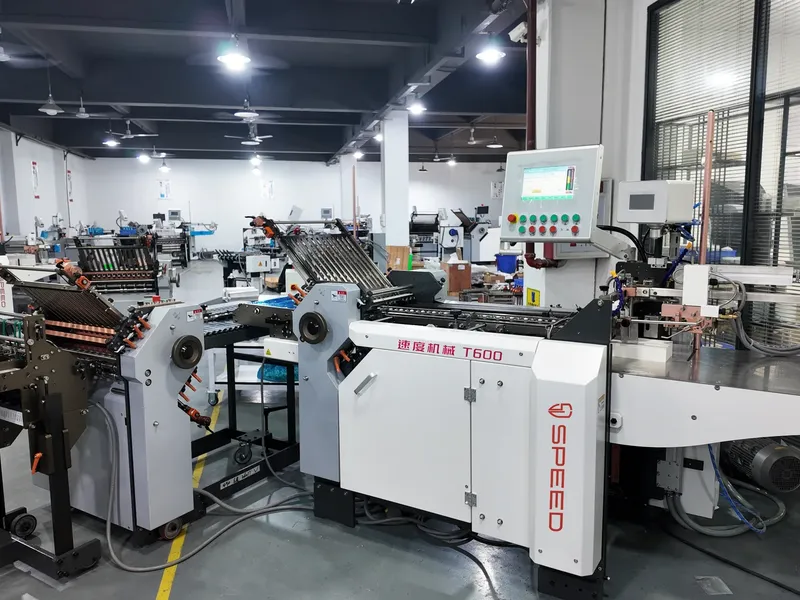
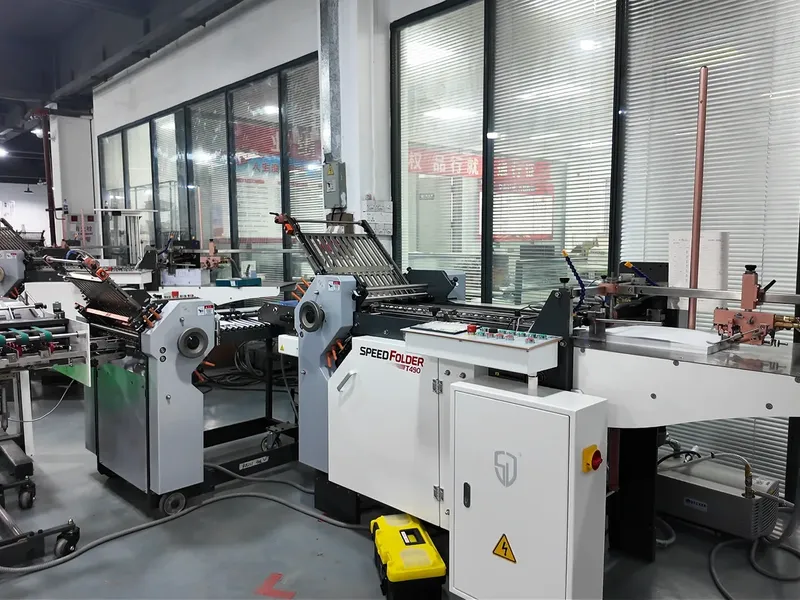
| In the SPEED range | T490, T520, T600, T780 platforms | Combination machines to order; SD-X250 parallel knife unit |
When buckle folding wins
- You quote a wide range of patterns and need them reachable from one machine without tooling changes.
- Your work is largely leaflet, brochure, mailer and insert folding in the 28–210 gsm band.
- You want plate count to be the flexibility lever: 10+4, 12+6 and 14+6 sets cover most standard patterns.
- Miniature pharmaceutical formats, where the T490 platform folds down to 60 × 100 mm sheets with a 20 mm minimum buckle fold.
When knife folding wins
- One specific fold must be identical on every piece, and the pattern does not change.
- Heavy cover stock or a stiff material would mark or crack in a buckle.
- A right-angle fold on thick stock is required in the same pass as the buckle folds.
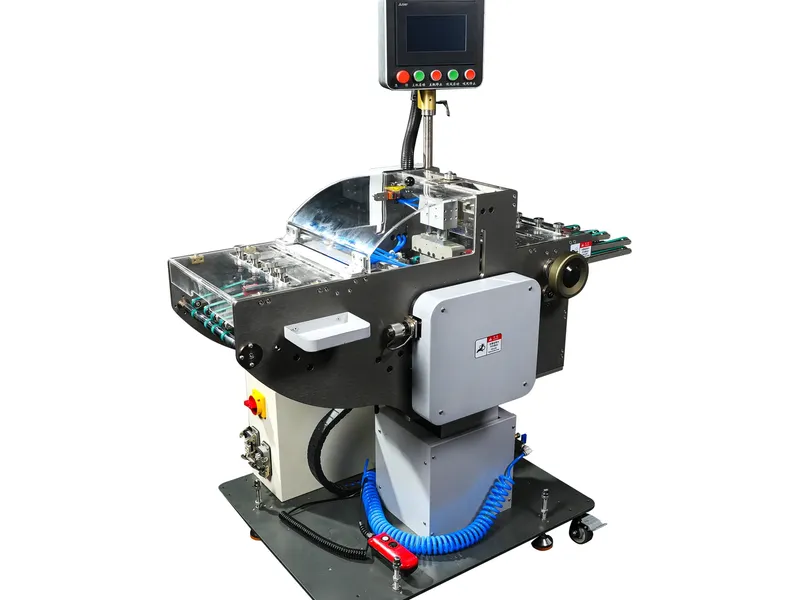
- The job is trimming or slitting a folded leaflet square, which a parallel knife unit such as the SD-X250 does inline at 30–90 m/min.
Why a combination machine is often the answer
The pattern list of a real print business rarely fits one mechanism. A brochure may need parallel buckle folds followed by a cross fold that is cleaner on a knife; a cover-stock mailer may need buckle folds for the panels and a knife fold for the final right-angle. Moving the job between two machines costs a handling step, a second setup and a second registration.
A combination machine carries both a buckle unit and a knife unit, so a combination pattern runs in a single pass on one machine. For pharmaceutical lines, the equivalent division of labour is a buckle folder (T490/T520) for the fold pattern plus an SD-X250 knife unit for trimming and slitting inline — a knife used for its precision on an edge rather than for the main fold.
How to decide in practice
Write down the fold patterns you actually quote and mark each as "reachable on a buckle", "better on a knife", or "must be trimmed". If the second or third column is empty, a buckle folder is the whole answer. If it is not, the decision is between a combination machine and an inline knife unit — and a fold test on your own stock at production speed is what settles it.
Note · Send the pattern list with the enquiry and we will fold each pattern on the appropriate mechanism and return the samples labelled with the machine used.
Frequently asked
Which is more accurate, buckle or knife folding?
Can a buckle folder do everything a knife folder can?
What does a parallel knife unit do?
Is a combination machine slower than a dedicated one?
Related footage
Accordion folding on a buckle folder
Concertina (accordion) folding produced by alternating buckle plates — no knife unit required.
Watch on YouTube →Multi-panel accordion and cross folds
A run through the standard multi-panel fold patterns: accordion, letter, gate and cross folds on one machine.
Watch on YouTube →